.png)


Last Updated on August 17, 2026
Last Updated on August 17, 2026





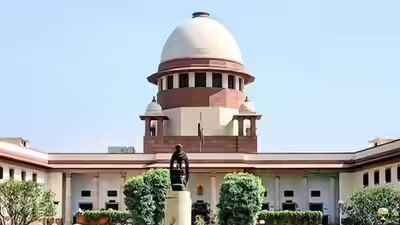
NEW DELHI: Contrary to West Bengal govt’s apprehensions that scrutiny of deleted voters’ claims for inclusion in voters’ lists would not be completed before filing of nominations for assembly elections later this month, Supreme Court on Wednesday said the Calcutta high court chief justice has informed that all 60 lakh-odd claims would be adjudicated by April 7.
A bench of CJI Surya Kant and Justices Joymalya Bagchi and Vipul M Pancholi said the Calcutta high court CJ has informed that out of 60,06,675 objections to deletion of names from voters’ lists, judicial officers — 500 from Bengal and another 200 from Odisha and Jharkhand — have decided 47,30,000 by Wednesday morning.
“Calcutta high court CJ has informed us that the pending objections are likely to be adjudicated by April 7. Keeping the aforesaid date in mind, post these matters on April 6 (for further hearing),” the bench said.
To appeal against the decisions of judicial officers, who were entrusted the task of electoral registration officers by Supreme Court using its extraordinary powers under Article 142 in the face of the state govt expressing serious doubts about the fairness of the process adopted by EC officials, SC had directed constitution of election tribunals — 19 have been notified by EC — comprising former HC CJs and former HC judges.
The bench said the appellate tribunals will have the discretion to “to revisit the full records, including the reasons assigned by judicial officers while adjudicating objections, before deciding appeals filed before them, and also to inform the parties of these reasons”.
Tribunals free to evolve own procedures: SC
The tribunals are free to evolve their own procedures in accordance with principles of natural justice, and are requested to adjudicate the appeals after providing the parties with a fair opportunity of being heard,” it said, adding those intending to file appeals before the tribunals would be provided with reasons given by judicial officers in rejecting their claims.
Senior advocate Kalyan Banerjee objected to EC giving a day’s training to former CJs and judges prior to commencement of work in the tribunals from Thursday. “Tribunals are quasi-judicial bodies. They must act independently. Why the training,” he asked. CJI said, “They are former CJs and judges of HCs. Obviously, they will act independently. Training is for handling computer and soft copies of documents. Don’t raise frivolous objections.” EC counsel and senior advocate D S Naidu said it is not training, but only orientation.
Justice Bagchi said, “They have vast experience in deciding matters. You must not be worried about EC influencing judges.” advocate Kapil Sibal said, “We must have the liberty to approach the HC CJ when we have some grievance.” The bench said, “Obviously, you have the right to approach the Calcutta HC CJ. But don’t go in a group or in a delegation. If you send a political delegation, we will tell the CJ not to entertain such delegations. Mr. Banerjee, or the advocate general, can go and meet. Where is the necessity of political workers to go and meet the CJ?”
Justice Bagchi said, “The problem is to the best of our knowledge and information, representations by political unions or associations are not only made to the HC CJ but also to district judges. We do not want judicial officers to be disturbed in this manner.
For clarifications/queries, please contact Public Talk of India at:
+91-98119 03979 publictalkofindia@gmail.com
For clarifications/queries,
please contact Public Talk of India at: