.png)


Last Updated on February 02, 2026
Last Updated on February 02, 2026





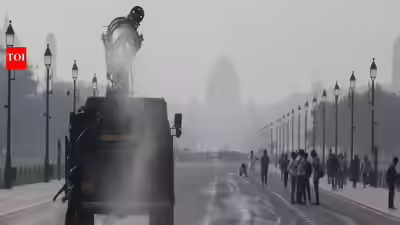
EW DELHI: The Union Budget 2026–27 on Sunday cut allocation for pollution control at a time when the toxic air quality of Delhi-NCR and the Indo-Gangetic Plains has set off alarm bells on an unfolding public health crisis.
The Centre has allocated Rs.1,091 crore for pollution control in FY 2026–27, which is Rs 209 crore lower than the revised estimates of Rs 1,300 crore in 2025-26 that was increased from the allocated Rs 853.9 crore that year.
The allocation falls under the Control of Pollution scheme, which funds pollution control boards, committees and the National Clean Air Programme (NCAP), Indias flagship initiative to reduce particulate pollution in non-attainment cities. The NCAP monitors pollution in 82 cities.
The decision triggered sharp criticism from environmental experts. They said the absence of a targeted approach for regions facing the worst pollution was a major gap.
Sunil Dahiya of Envirocatalysts pointed out that the Budget failed to address the regional nature of the crisis. There is no dedicated allocation for Delhi-NCR or north India, even as air pollution remains a recurring health emergency. Emission reduction at source needs strong policies and financial backing, which are missing, he said.
Dahiya added that while the overall Control of Pollution head showed a marginal rise, NCAPs funding across the 82 cities is lower this time than last years revised estimates, which is a worrying signal. He also flagged the absence of focused support for EV infrastructure, calling this a significant miss.
Anumita Roychowdhury, executive director at the Centre for Science and Environment (CSE), aired similar concerns. She said the allocation did not match the scale of the crisis. The decline in budgetary support has raised doubts about how NCAP 2.0 can be expanded without a commensurate increase in central funding, even if convergence with other sectors is planned, she said.
Environmental activist Amit Gupta found the budget deeply disappointing. The NCAP allocation was cut by nearly Rs 200 crore. What is even more alarming is that in FY 2024–25, only Rs 16 crore was spent against an allocation of Rs 900 crore.
While the budget boosts clean energy spending, experts argued that this did not translate into a strong anti-air pollution strategy. Aarti Khosla, founder and director of Climate Trends, noted that a record allocation was made for rooftop solar panels, but more could be done. This shows intent for energy transition, but given the extent of air pollution, stronger measures such as accelerating EV adoption and fast-charging infrastructure were needed, she said.
Vibhuti, director (south Asia) at IEEFA, said transport electrification remained a missed opportunity. EVs can deliver immediate public health benefits, yet the budget support remained weak, she said.
However, some increases were seen for regulatory bodies. The Commission for Air Quality Management (CAQM) received Rs 35.26 crore, a Rs 4 crore jump; CPCB received Rs 123 crore against Rs 116.2 crore in FY 2025–26, and allocations for environmental education and capacity building also rose.
Rs 104 crore was allocated for environment education, awareness, research and skill development, a jump of Rs 29 crore against 2025-26. A jump of Rs 33.8 crore was seen in environmental knowledge and capacity building (Rs 102.7 crore) for FY 2026–27.
For clarifications/queries, please contact Public Talk of India at:
+91-98119 03979 publictalkofindia@gmail.com
For clarifications/queries,
please contact Public Talk of India at: