.png)


Last Updated on January 16, 2026
Last Updated on January 16, 2026





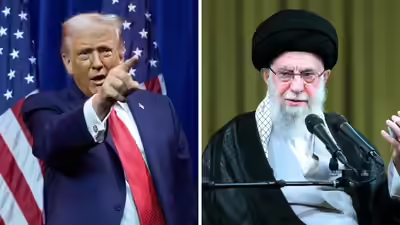
US President Donald Trump was presented with an expanded menu of options that could be used to attack Iran, including military, cyber and psychological operations, as more than 600 people have been killed in nationwide protests in the Islamic Republic, several US media outlets reported on Tuesday, citing defence sources.
The defence sources told CBS News and The New York Times that air power and long-range missiles remain central to any potential military response against Iran. However, the Pentagon has also outlined cyber operation options and psychological campaigns aimed at disrupting Iranian command structures, communications networks and state-run media.
Cyber, psychological operations part of plan
Officials said cyber and psychological operations could be carried out alongside traditional military force, in what military planners describe as integrated operations, or be deployed as stand-alone measures.
Defence officials did not specify which digital infrastructure could be targeted or what the psychological campaign against Iran’s state-run media would entail if Trump were to authorise such actions.
Nuclear, missile sites among possible targets
Meanwhile, The New York Times reported that potential targets could include Iran’s nuclear programme, expanding beyond the US airstrikes that battered it in June, as well as ballistic missile facilities.
Trump’s national security team is scheduled to meet at the White House on Tuesday to discuss updated options on Iran, CBS News reported, citing officials familiar with the matter. It remains unclear whether the president will be present at the meeting.
‘Diplomacy is always the first option’
Despite the expanded military planning, officials stressed that no final decision has been taken and that diplomatic channels remain open.
“Any attack is at least several days away and could prompt a vigorous retaliation from Iran,” an official told The New York Times. Some US officials believe Iran is attempting to delay a potential US attack rather than engage seriously in diplomacy.
Earlier on Monday, White House press secretary Karoline Leavitt said Trump is “unafraid to use military options if and when he deems necessary”, but emphasised that “diplomacy is always the first option”. She added that “what you’re hearing publicly from the Iranian regime is quite [different] from the messages the administration is receiving privately.”
Iranian foreign minister Abbas Araghchi has reached out to US special envoy Steve Witkoff to explore direct diplomatic talks, according to two sources familiar with the matter. A possible meeting is under discussion.
However, it remains unclear what issues Tehran is prepared to negotiate. The two sides held talks last spring over Iran’s nuclear programme, which Iranian leaders say is for civilian use. US and Israeli officials, however, fear it could be diverted to produce nuclear warheads.
Tariffs ramp up pressure
Trump has announced a 25% tariff on countries doing business with Iran, escalating pressure on Tehran over its violent crackdown on nationwide protests. The president said the tariffs would take effect immediately.
“Effective immediately, any country doing business with the Islamic Republic of Iran will pay a tariff of 25% on any and all business being done with the United States of America,” Trump said in a social media post.
Protests spread, internet cut
Protests have spread across all 31 provinces of Iran for more than two weeks. At least 644 people have been killed, according to Human Rights Activists News, which said most victims died from live ammunition or pellet gunfire, often at close range.
The Iranian government has also cut internet services nationwide, creating an information blackout. Leavitt said Trump had asked Elon Musk to explore whether SpaceX could provide internet access to Iranian citizens via the Starlink satellite network.
Trump warns of retaliation
Asked how the United States would respond if Iran were to strike American military bases, Trump said, “We will hit them at levels that they’ve never been hit before.”
Speaking aboard Air Force One, Trump said Iran appeared to be approaching a red line he had set, adding, “They’re starting to, it looks like.”
Iranian President Masoud Pezeshkian accused the United States and Israel of attempting to destabilise Iran by fomenting unrest. While pledging that the government would hear public grievances, he warned against violent protesters and urged Iranians to stay away from “rioters and terrorists.”
For clarifications/queries, please contact Public Talk of India at:
+91-98119 03979 publictalkofindia@gmail.com
For clarifications/queries,
please contact Public Talk of India at: