.png)


Last Updated on January 07, 2026
Last Updated on January 07, 2026





New Delhi:
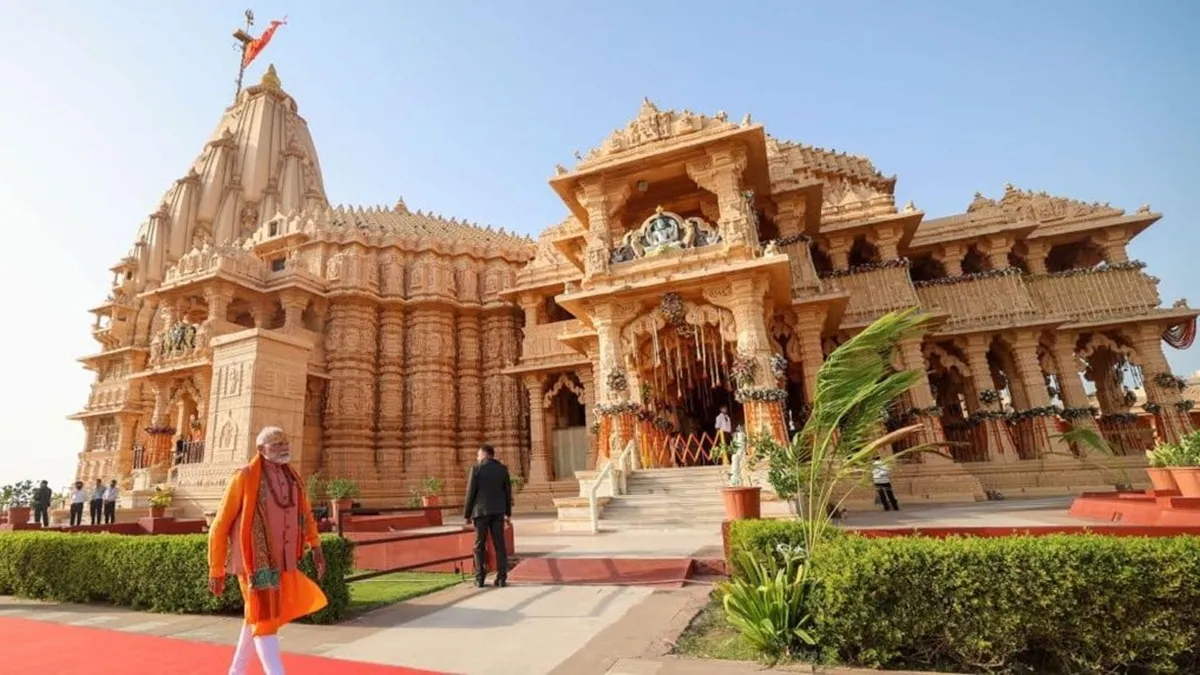
Prime Minister Narendra Modi on Monday hailed the Somnath Temple in Gujarat, which was rebuilt after repeated attacks by foreign invaders, as a symbol of the indomitable spirit of Indian civilisation. In a blogpost to mark 1,000 years since the first attack on the Somnath Temple, PM Modi said, There can be no better example of our civilisations indomitable spirit than Somnath, which stands gloriously, overcoming odds and struggle.
PM Modi said 2026 marked 1,000 years since the first attack on the Somnath Temple took place and despite repeated attacks subsequently, the temple stands tall.
This is because Somnaths story is about the unbreakable courage of countless children of Bharat Mata who protected our culture and civilisation, the prime minister said.
He said it was the same spirit that was visible in the nation, which has emerged as one of the brightest spots of global growth, having overcome centuries of invasions and colonial loot.
It is our value systems and the determination of our people that have made India the centre of global attention today. The world is seeing India with hope and optimism. They want to invest in our innovative youngsters, PM Modi said.
Our art, culture, music and several festivals are going global. Yoga and Ayurveda are making a worldwide impact, boosting healthy living. Solutions to some of the most pressing global challenges are coming from India, PM Modi said.
The prime minister said the aggressors of the past were now dust in the wind, their names synonymous with destruction. They are footnotes in the annals of history, while Somnath stands bright, radiating far beyond the horizon, reminding us of the eternal spirit that remained undiminished by the attack of 1026, he said.
With the blessings of Shree Somnath Mahadev, we move forward with a renewed resolve to build a Viksit Bharat, where civilisational wisdom guides us to work for the welfare of the whole world, the prime minister said.
The temple was attacked and plundered many times, including by Turkish ruler Mahmud Ghazni in 1024 AD. PM Modi recalled that Sardar Vallabhbhai Patel played a key role in rebuilding the Somnath Temple after Independence.
A visit during Diwali time in 1947 moved him so much that he announced that the temple will be rebuilt there. Finally, on May 11th 1951, a grand Temple in Somnath opened its doors to devotees and Dr. Rajendra Prasad was present there, he said.
PM Modi said Sardar Patel was not alive to see the opening of the Somnath Temple on May 11, 1951, but the fulfilment of his dream stood tall before the nation.
Know history of Somnath Temple
In 1299 AD, Alauddin Khilji’s general Alaf Khan again destroyed the shrine, carrying fragments to Delhi. Once more, Hindu rulers rebuilt it.
In 1394, Muzaffar Khan, a governor of Gujarat, again destroyed the temple. Some sort of Shrine must have been built again. In 1459 AD Mahmud Begda or Muzaffar II again desecrated the Somnath temple.
Till 1669 AD, the temple nevertheless continued to function as a sacred shrine of Hindus, when Aurangzeb ordered its demolition along with other Hindu shrines in the country. In 1702 AD Aurangzeb ordered to destroy Somanatha temple beyond repair. In 1706 AD, the shrine was converted into a mosque on order of Aurangzeb.
Queen Ahilyabai Holkar, recognizing the sacred continuity, built a new temple nearby in 1783. To save it from destruction the Linga was placed in a secret underground shrine immediately below the usual upper one.
For clarifications/queries, please contact Public Talk of India at:
+91-98119 03979 publictalkofindia@gmail.com
For clarifications/queries,
please contact Public Talk of India at: